
Magdalena Abakanowicz – The Thread of Existence
Musée Bourdelle, Paris. 20/11/2025 – 12/4/2026

Curated by Ophélie Ferlier-Bouat and Jérôme Godeau, with Colin Lemoine
I first saw the work of Magdalena Abakanowicz in Poland almost twenty years ago. It might have in the Museum Sztuki, or the Central Museum of Textiles, both in Łodz. At that time, space in Polish art institutions was as ample as money was scarce, benefiting the sort of large-scale sculptures and installations Abakanowicz specialised in. You need to walk around these works and see them from every angle. You need to smell them. Made mostly of textile, detailed viewings are necessary too, to appreciate the range of textures, techniques and materials. Abakanowicz was still alive then; she was highly celebrated in Poland. She died in 2017, aged 86.
The Thread of Existence is the artist’s first major exhibition in France. The Musée Bourdelle supplied tri-lingual wall plaques; later it occurred to me that this quantity might have contributed to the lack of quality in the texts. Fundamental references and connections were missing: for instance, the relationship of Abakanowicz’s figural works to the cheerless, sometimes grotesque, characters who populated the set designs of multidisciplinary theatre titan Tadeusz Kantor. Both artists were forged in the crucible of Nazism, working through the subsequent decades of oppressive communism. Similar too, their dark broody palette and coarse textures. But I did not see Kantor’s name mentioned anywhere.
Abakanowicz began as a painter, studying in Gdynia and Sopot shortly after Poland won these Baltic territories back at the end of WW2. Then she went down to Warszawa, and by the end of her art degree in 1954, had moved to textile as a favoured material. She had a reverential attitude to fibre, considering it ‘the greatest mystery of our environment. All living organisms, plants, leaves, and ourselves are built from fibre. Handling it we handle mystery. … Fabric is our covering and our attire. Made with our hands, it is a record of our souls.’
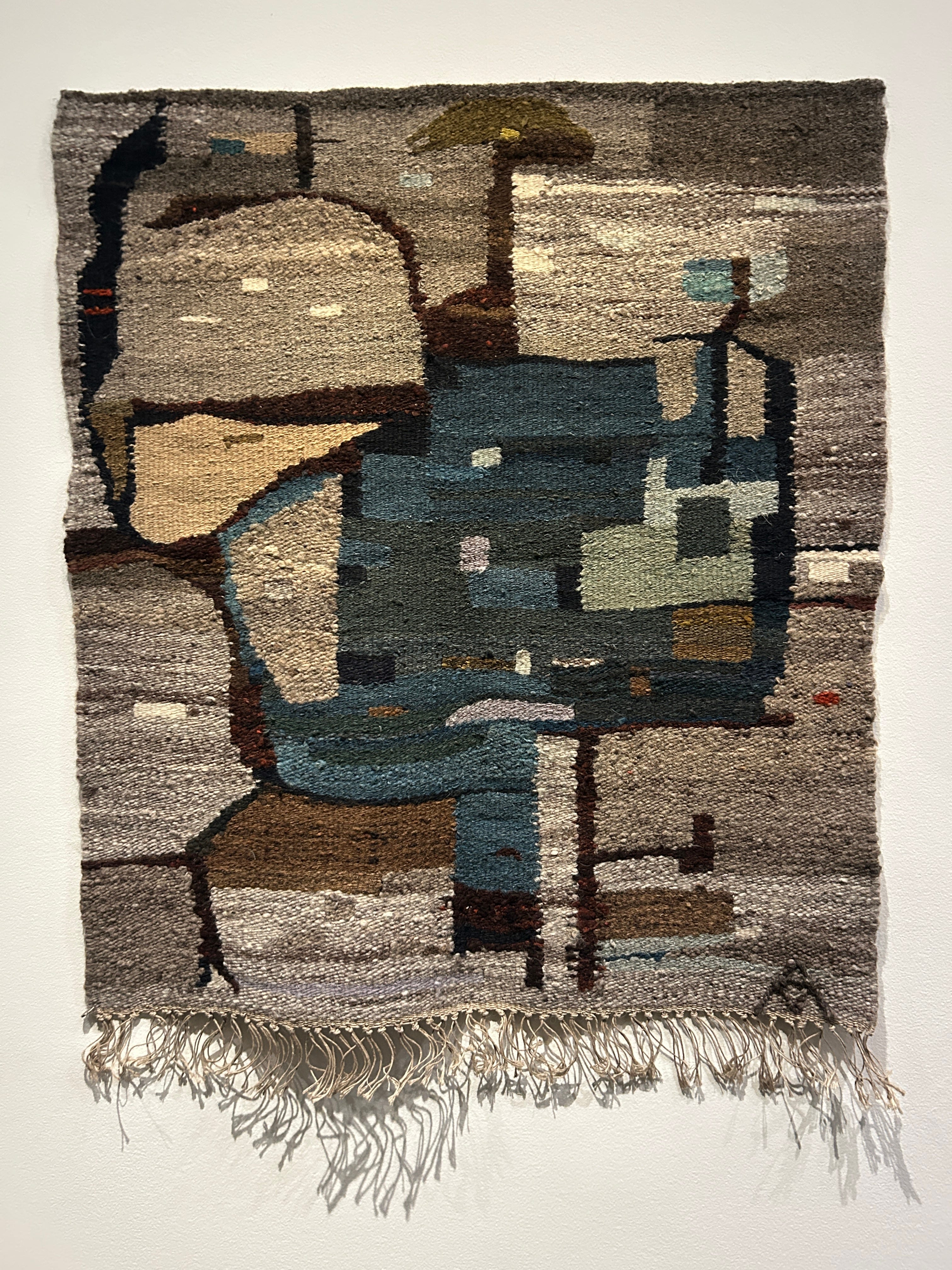
Tapestry, 1963
It’s a fabulous proposition, both earthy and spiritual, drawing you close to the work. An early tapestry shows Abakanowicz’s natural feel for colour and tone. It’s abstract but I can’t help seeing suggestions of houses, or fields, or maybe only fields of colour. One might also think of the shaggy outlines of Polish crops as viewed from a plane, contrasting with the rigid grids of Germany. Knots are smooth or unfinished; the warp and weft have a deliberate, skilful irregularity.
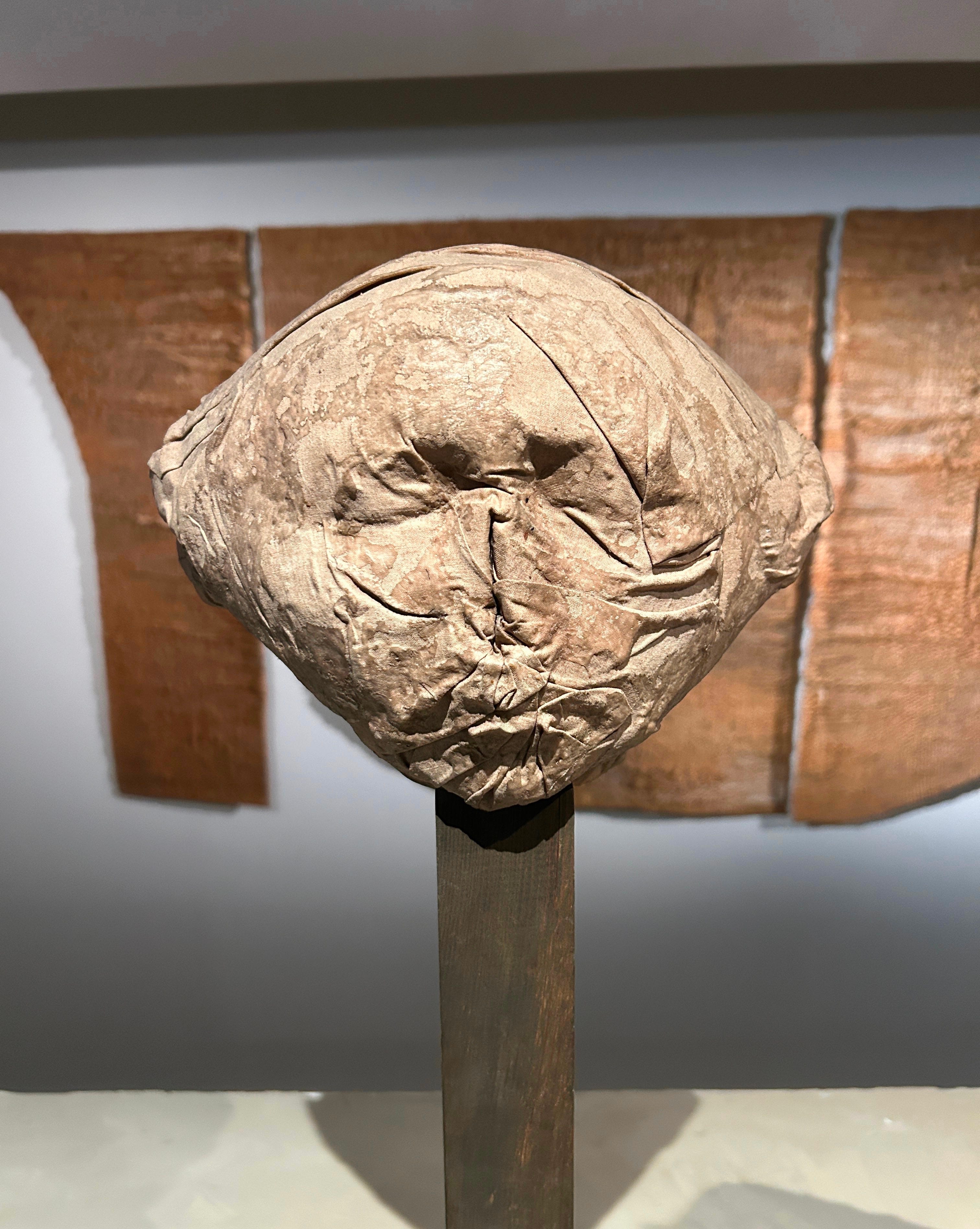
In this first corridor are also life-size heads crudely moulded from fabric, mounted on metal posts. The imprints of the artist’s hands are visible, the eyes deep jabs, lending a tortured quality to the faces. You can’t not think of what Abakanowicz went through, articulated by the poets of her generation - Czesław Miłosz, Wysława Szymborska, Tadeusz Röséwicz. She saw Nazis shoot her mother’s arm off when she was fourteen. Then in 1944, the family fled the arrival of Soviet troops, losing all their possessions.
The heads barely qualify as busts. The repetitiveness and distortion reminded me of Mike Parr’s self-portraiture. Obsessively redoing in a bid for perfection, or destruction, or an infinite frustrated search. How can we ever really know what goes on inside a human head? These, and other sculptures made of sackcloth, broken shells, and various fabrics and fibres, began to be known as ‘Alterations’.
There is a sculpture made from ship lines: discarded maritime rope, thick as a forearm, scarred and greased. Such materials would have been easy to scavenge on the Baltic. The ship lines would once have been funky with diesel, brine, and decades of human and amphibian contact. Abakanowicz wanted all the senses stimulated by her fibre-based work, but you have to get very close to them now, so long after they were made, for an olfactory effect.
The most striking works, those Abakanowicz is best known for, and began to exhibit globally in the 1970s, are what a Polish critic in the late 1960s termed the Abakans, ‘spacial textile works’. These monumental hanging sculptures were made to tower over people, their forms shifting and morphing from every angle. Many were dyed bright colours, deep browns or black, and all along their surfaces, thick ropes of sisal unfurl across dense mats woven from hemp and cotton, or salvaged materials famously stored under the artist’s bed. Sections done with small stiches abut against chunky ones. This exhibition claims to focus on the Abakans, renovating a 600m2 space to accommodate them. But this was not successful.
Red Abakan (1969) with its sharp nose-like protuberance hung with labial folds, its wide, billowy elephant ears and intense blood red, is one of Abakanowicz’s best known. Sequestered into a corner behind ropes and bollards, beneath a low ceiling, has a fatal affect. Mounting a mirror behind it doesn’t solve the problem of the audience being cut off from such a radiant, vibrant work. The Abakans were about breaking boundaries, the spectacular and the unruly; they were a rebellion against the restraints and conventions of the political climate of late 60s Eastern Europe. Tapestry and textiles have a long folkloric tradition in Eastern Europe and as such were acceptable to the oppressive regimes: Abakanowicz’s explosions of the forms were also metaphorical (and theatrical). The containment of this Abakan, complete with security guard, backfires as repudiation. Abakan Orange (1971), a large, round burnt orange mat with a cunty ripple along the centre, a slender sword-like piece suspended above, is similarly anticlimactic due to its cramped installation.
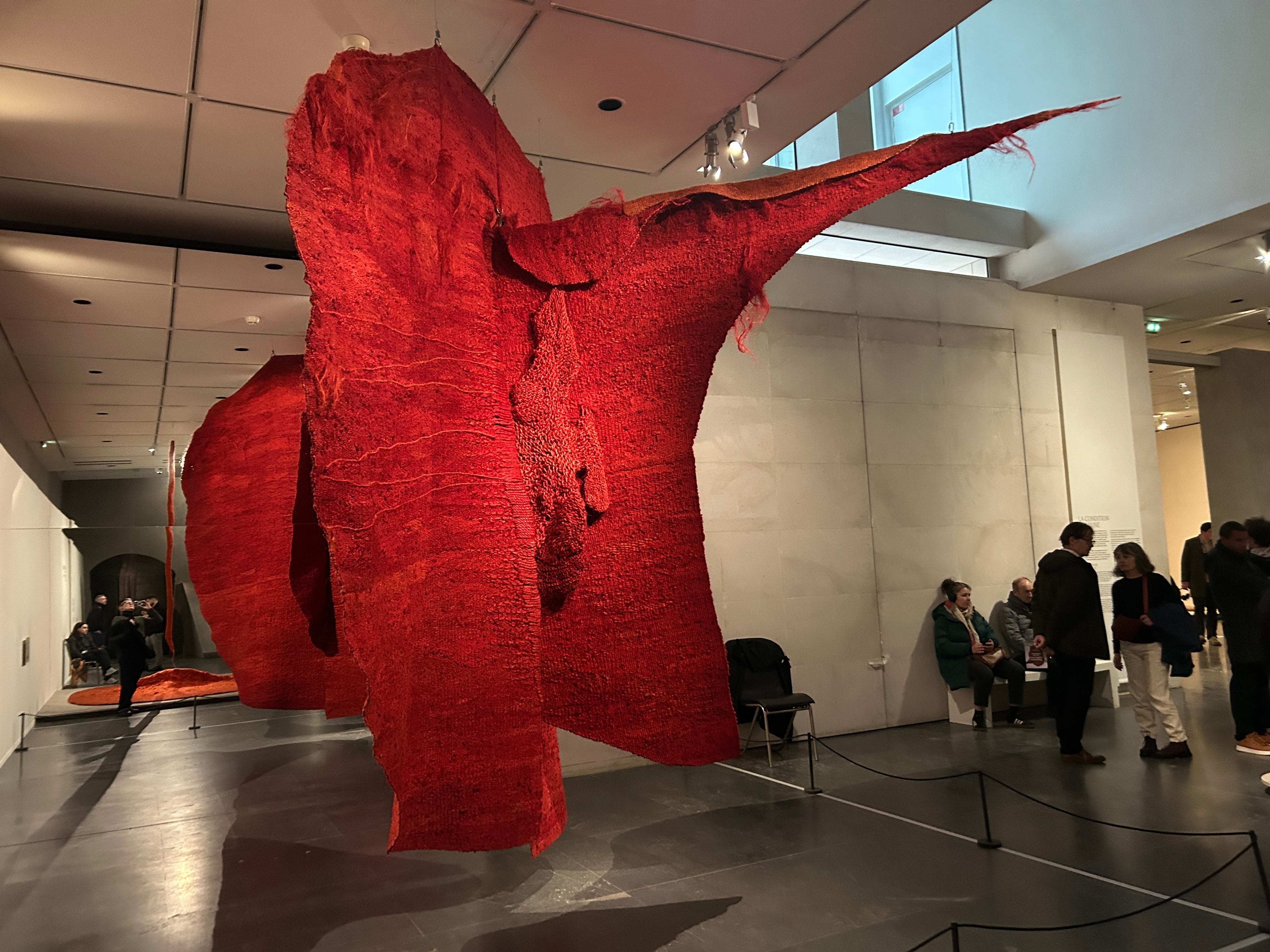
Red Abakan (1969)
The galleries of the Musée Bourdelle are better suited to Abakanowicz’s smaller sculptures of nests, eggs and cocoon-like shapes, or her explorations of the human figure, begun in the 1970s. Some nestle in concrete alcoves. Beginning with her installation Backs done for the 1980 Venice Biennale, Abakanowicz explored the theme of the crowd. She used moulds of a male human body, lined them with burlap coated in resin or glue, then individualised them with folds, seams, creases and hollows. She exhibited them with their backs to the audience. In the Musée Bourdelle, the headless bodies are lined up in rows facing us, uncanny, unfriendly. The dun-coloured crowd is a familiar motif of communist era art. ‘In my childhood,’ Abakanowicz said. ‘I witnessed how masses worship on command and hate on command.’
The group of headless figures is also – as the catalogue essay will tell you – ceremonial. It goes on: ‘Abakanowicz was thus revitalising the ritual dimension of sculpture as she had experienced it in Papua New Guinea.’ It’s an inadequate citation, rendering a whole culture anonymous and homogenous. Contemporary presentations of European art are less reductive in their references to Indigeneity than they used to be, but the debts owed, the tremendous range and complexity of colonised cultures from the global south that underpin so much twentieth century European art, are still not being adequately acknowledged. There are references to Butoh that are a bit obtuse, but don’t impel the same queasy feeling of an asymmetrical extractive process.
The problem may begin with the artist themself. I have no idea how mindful Abakanowicz was about her influences, but my teeth still grind when I read phrases like ‘For the first time in the world—‘, knowing that the technique, object, concept or intention has been extant in an Indigenous culture for millennia. My companion at the exhibition, a Frenchman who has lived and worked a lot in Latin America, was alert to this, citing the rich traditions of textile art across that continent, with pieces having multiple functions – garment, mat, carry-bag, ritual object, signifier of a family name, territorial marking, reiteration of scarification or tattoo or other body modification. And so on.
It’s strange, if not egregious, given Abakanowicz’s first great leap on the international stage was at Sao Paolo Biennale in 1965. She must have thrilled to the centrality of weaving and textiles across the Americas. The focus on flora and fauna, the bright colours, the matriarchal and domestic traditions, the pagan Catholicism - all these threads connecting to Eastern European folkloric tradition, were barely teased out.
Abakanowicz did some beautiful charcoal drawings, mesmeric ovoid scrawls related to the eggs and cocoons. Her ink washes are even better, the Compositions series showing embryonic forms created with thick black outlines containing delicate splodgy washes. They are fulgent, dreamy, and pulse with life.
Another great addition to the exhibition is a film shot in the house that Abakanowicz shared with her lifelong partner and Husband, Jan Kosmowski, on the outskirts of Warsaw. (Much in this house has been preserved and is open to visitors.) Footage of the artist weaving shows her dexterity and technical audacity, the unconventional patterns and lines she pursued, often combining different threads. Fleece, horsehair, silk, anything could be used. Her palette by contrast – apart from sun-kissed abakans - was organic, refined, subtle.
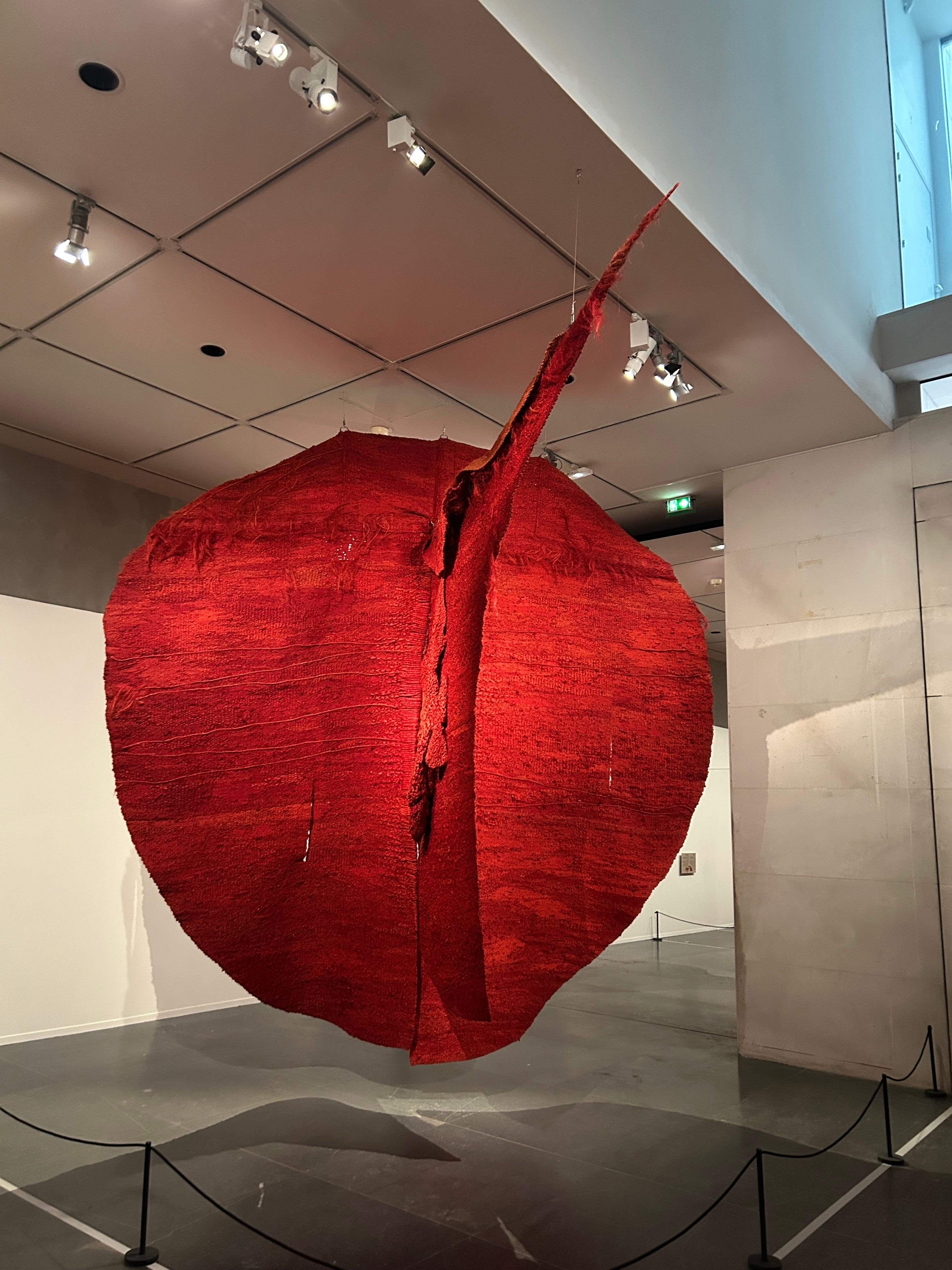
A vast amount of work went into this exhibition, but its limitations are self-imposed. Adjacent to the carefully constructed spaces showing Abakanowicz’s work is a huge gallery exhibiting the permanent collection of Pierre Bourdelle’s monumental sculptures. Done mostly around the turn of the last century, many on commission for the Argentine government, they are blocky brutalist works, lacking the expressive sensuality of Rodin, Bourdelle’s contemporary. Bourdelle achieved great success in his lifetime: the museum, just five minutes walk from Gare du Montparnasse, is in premises occupied by the artist and his family for over forty years. As his earnings grew, Bourdelle gradually bought up adjacent properties, also building two sculpture gardens. I couldn’t help thinking how wonderful it would have been if this vast, high-ceilinged gallery had been cleared of Bourdelle’s work to make way for the Abakans, both the cramped masterpieces already shown, and more.
*******
A coda:
I found another photo from the exhibition. It’s of a work that I didn’t like much. But maybe I did - otherwise why would I have photographed it? These weird creatures, called Mutants, were done in the 1990s when the artist was in her sixties.
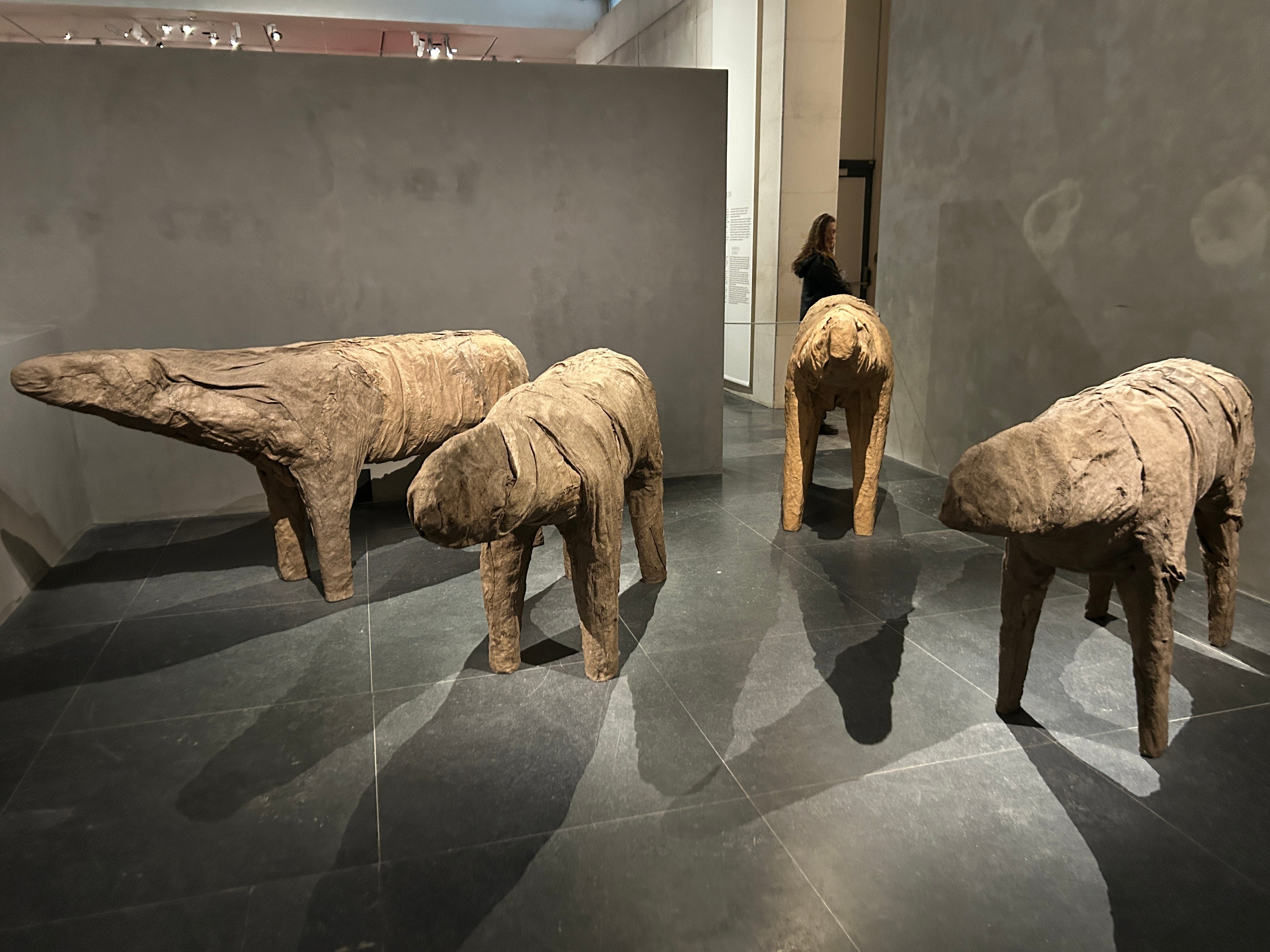
Mutants, 1994-96
I think the image has stayed with me because, like The Crowd, it seems so archetypal an image of art produced under authoritarian rule. It is anti-aesthetic, anti-beauty. The work-horse, the sameness, the mute submission. And I have wondered why these sculptures didn’t resonate with me more considering we are now in a new age of authoritarianism.
But it’s the opposite kind of authoritarianism. One of rampant individualism: its script is actually predicated by this. A glossy, cacophonous world where art, culture and advertising merge. Where free speech is an illusion offered by tech oligarchs, whose logarithms’ censure of certain words and images gags individuals as soon as they speak. I should know: it has happened to me on Meta. For using words like Palestine, genocide, Israel, rogue state, war crimes, apartheid, fascist USA.
So now I’ve moved to substack, to tap away to my tiny audience. I’m enjoying it; it’s a small but valid freedom.
People warned me about substack. They said it was a cesspit of Nazis. Marcia Langton is onto them. She posted an image of a Nazi group a few weeks ago, imploring her followers to help shut them down. I went to their page to report them for racism and inciting violence, but I kept getting an error message. It really bugged me. I wondered if it was the language I used. So I thought I’d get my camp on, and return to report them for Bad Taste, or Crimes against Aesthetic Innovation, given their banner was just a plain old red black and white swastika. But I couldn’t find them.
Did Marcia manage to shut them down? Or is it us who’ve been blocked from them? Will I be shadow-banned now? Check this article on Marcia’s page. And if you’ve read this far, please click like to help push past the shadow ban if it’s there. And if you’re interested in reading about the Poland that I experienced, my travel memoir Strange Museums is still available for order direct from me.
thanks for introducing me her.
This is wonderful